
Dealership call routing: a map for service, sales and F&I
Most dealership calls are about service and parts, yet most phone trees lead with sales. Here is a routing map by call type, with what an AI phone agent may handle and the FTC and FCC rules that shape F&I calls and AI callbacks.
Updated November 1, 2026
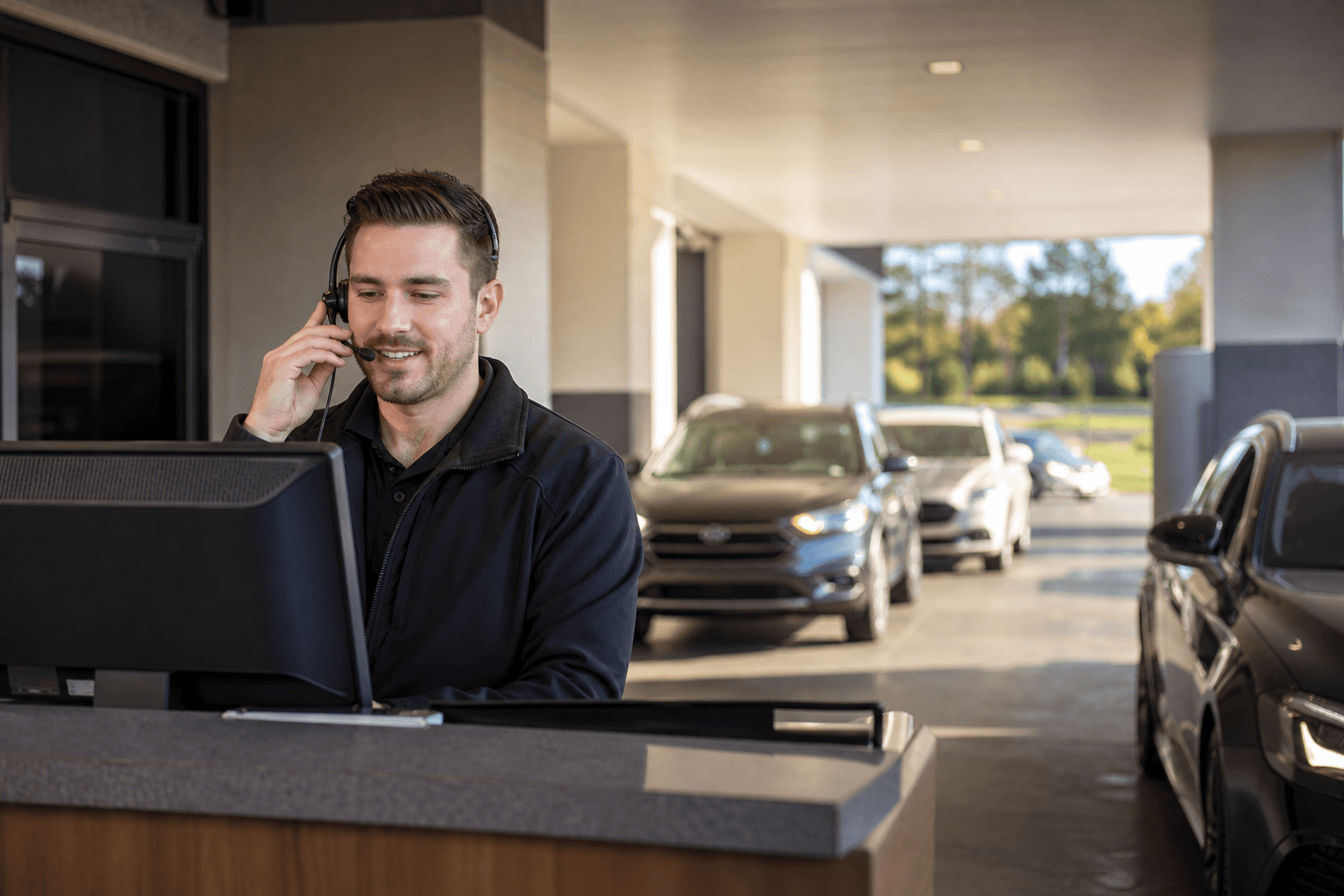
Dealership call routing decides what happens in the first half minute after someone dials your store: whose phone rings, what the caller has to press, and where the call lands when nobody picks up. Most dealer phone trees mirror the org chart. Callers don't think in org charts. They want a service slot, a part, a number on a used truck or a payoff figure, and the routing should get them to that answer in as few steps as it can.
This post sorts dealership calls by type and says who should answer each one first, what happens when that person is busy, and which parts an AI phone agent can take on under rules your managers set.
What does good dealership call routing look like?
Good dealership call routing sends each caller to the person or system that can finish the request on the first call, and it never dead-ends in a full voicemail box. In practice that means a short front door of one or two questions, a named fallback for every department, and a written rule for after hours.
The fallback matters more than the menu. A ring group that rings four salespeople and then drops into a general mailbox nobody checks is a routing plan with a hole in it. The idea behind search intent applies to a phone menu too: work out what the caller is trying to do before you decide where they go.
Which calls does a dealership actually get?
Service and parts calls are most of the volume at a typical franchise store. A Marchex Institute analysis of more than 8 million calls to dealers of 16 car brands found that nearly 70 percent of inbound dealership calls were parts and service inquiries, and a little over 10 percent were new or used vehicle sales opportunities. The same report found more than 19 percent of calls went unanswered or were abandoned, and more than 10 percent of the callers who abandoned did so during the automated routing or voicemail process.
That report is from 2017, and your mix will differ by brand and store. Newer datasets exist: Car Wars analyzed more than 48 million inbound calls across nearly 3,000 dealerships for its 2025 mid-year study. The lesson from the older numbers still holds. If your phone tree opens with "press 1 for sales," you put the smallest group of callers first and make the largest group wait through a menu, which is exactly where the Marchex data shows people hanging up.
Pull a month of your own call logs before changing anything. Count calls by department and by hour, and mark how many ended in voicemail or a hang-up. That is your baseline.
How should service calls be routed?
Service calls should reach someone who can book, reschedule or give a status inside the first ring cycle, and the overflow should be able to book too. Booking is the most common service request and the most repeatable one, so it is the best job for an AI phone agent working only inside the appointment slots your service manager opens.
Status calls ("is my car ready?") are different. Route them to the advisor on the repair order. If that advisor is with a customer, take a message and text the caller when to expect an answer. No system should guess at a repair status it cannot read. Recall and warranty questions need an advisor's judgment, so the overflow captures the VIN and the concern and books a diagnostic rather than answering.
How should sales calls be routed?
Sales calls should ring a named salesperson or the BDC first, then fall to someone or something that captures the vehicle, timeline and trade before the caller hangs up. When a caller asks for a specific salesperson, ring that person, then the BDC or desk manager, then the receptionist or AI phone agent that takes details and books a visit.
Any sales call that still goes unanswered should get a missed-call text back with a person's name in it, so the shopper has a written reply instead of a silent line.
Where can an AI phone agent help, and where should it stay out?
An AI phone agent is useful on calls with a clear, repeatable outcome, such as booking a service slot or qualifying a sales lead, and it should stay out of money, credit and complaints. Market Canopy handles this with three permission levels: Canopy acts where you allow it, asks where you want a say, and never touches what you deny. We used the same sorting for a property management chatbot, and it carries over to a dealership with different call types.
Call type | First answer | When busy or after hours | AI permission |
|---|---|---|---|
Service appointment or reschedule | Service advisor or service BDC | AI books into open slots and texts a confirmation | Allow |
Repair status | Advisor on the repair order | Message, plus a text with the callback time | Ask |
Recall or warranty question | Service advisor | AI captures VIN and concern, books a diagnostic | Ask |
Parts availability and price | Parts counter | AI takes part and vehicle details for a callback | Ask |
New or used sales inquiry | Named salesperson or BDC | AI qualifies and books a visit; missed-call text back | Allow to qualify and book, Ask before quoting a price |
Trade-in value | Sales manager or appraiser | AI books an appraisal | Deny quoting a value |
Finance, payoff or credit question | F&I office or accounting | Message for a human callback | Deny collecting financial details |
Complaint | Service or general manager | Handoff or manager callback the same day | Deny resolving it alone |
Because Market Canopy keeps phone, SMS, live chat and email history in one record, the advisor who returns a call can see what the caller already told the AI or the receptionist.
How do F&I calls fit with the FTC Safeguards Rule?
Calls that touch financing should go to people, not to an AI phone agent or a shared voicemail, because most dealers that finance or lease vehicles are covered by the FTC's Safeguards Rule. According to the FTC's Safeguards Rule FAQ for automobile dealers, the rule dates to 2003, implements the Gramm-Leach-Bliley Act and applies to most dealers who finance or lease. A 2021 amendment requires a written information security program, and a 2023 amendment requires reporting certain data breaches and security incidents to the FTC. The program names a qualified individual to oversee it, who can be an employee or someone at an affiliate or service provider. The FAQ notes it reflects FTC staff views and is not binding.
Phone systems record calls, transcribe them and store messages, so they can end up holding customer information. Before you route any finance call, ask your phone vendor where recordings live, how they are encrypted and who can open them, and put the answers in your security program. Market Canopy lists AES-256 encryption at rest, multi-factor and Google sign-in, and tenant isolation on every query. Your compliance lead decides whether that fits your program; this post is not legal advice.
Can an AI agent call customers back for the dealership?
An AI agent answering an inbound call is a different case from an AI voice dialing out. In February 2024 the FCC confirmed that the TCPA applies to AI technologies that generate human voices, so outbound calls using those voices require the prior express consent of the person called. For service reminders or sales follow-up by AI voice, check consent records first. Where consent is missing or unclear, have a person make the call.
What should happen to after-hours calls?
After-hours calls should be answered, not sent to voicemail. An AI phone agent or answering service can book service, capture sales leads and leave a callback task for the morning crew. Route by department hours rather than store hours, since service and sales often keep different schedules.
A setup checklist for dealership call routing
Pull 30 days of call logs and count calls by department, by hour and by outcome.
Cut the front door to one or two questions, with service first if service is your biggest group.
Give every ring group a maximum ring time and a named fallback.
Write an Allow, Ask or Deny rule for each call type in the table above.
Put finance calls on a human-only path and add your phone vendor to your Safeguards program.
Check consent before any outbound AI voice call.
For the first month, listen each week to ten calls that ended in a hang-up and adjust the routing.
Sources
#after-hours answering#call routing#auto dealerships#AI phone agent#missed-call text back
Related posts

After-hours answering for real estate seller calls
Most sellers call only one agent, so the 9 p.m. call is the interview. Here is what an AI phone agent can handle alone, what needs an agent's approval, and what it should never say.
Overflow answering service: human, AI or text back
An overflow answering service catches the calls your team can't take during open hours. Here is how to choose between a human service, an AI phone agent and missed-call text back, and what each should be allowed to do.

Lead callback: how fast to call, who calls and when to stop
The HBR study behind the one-hour rule, a callback sequence a small team can run, which steps an AI can take on its own, and the FCC rules on AI voice calls and opt-outs.